Traditional Beetroot Halwa Recipe (Rich, Velvety, No Earthy Taste)
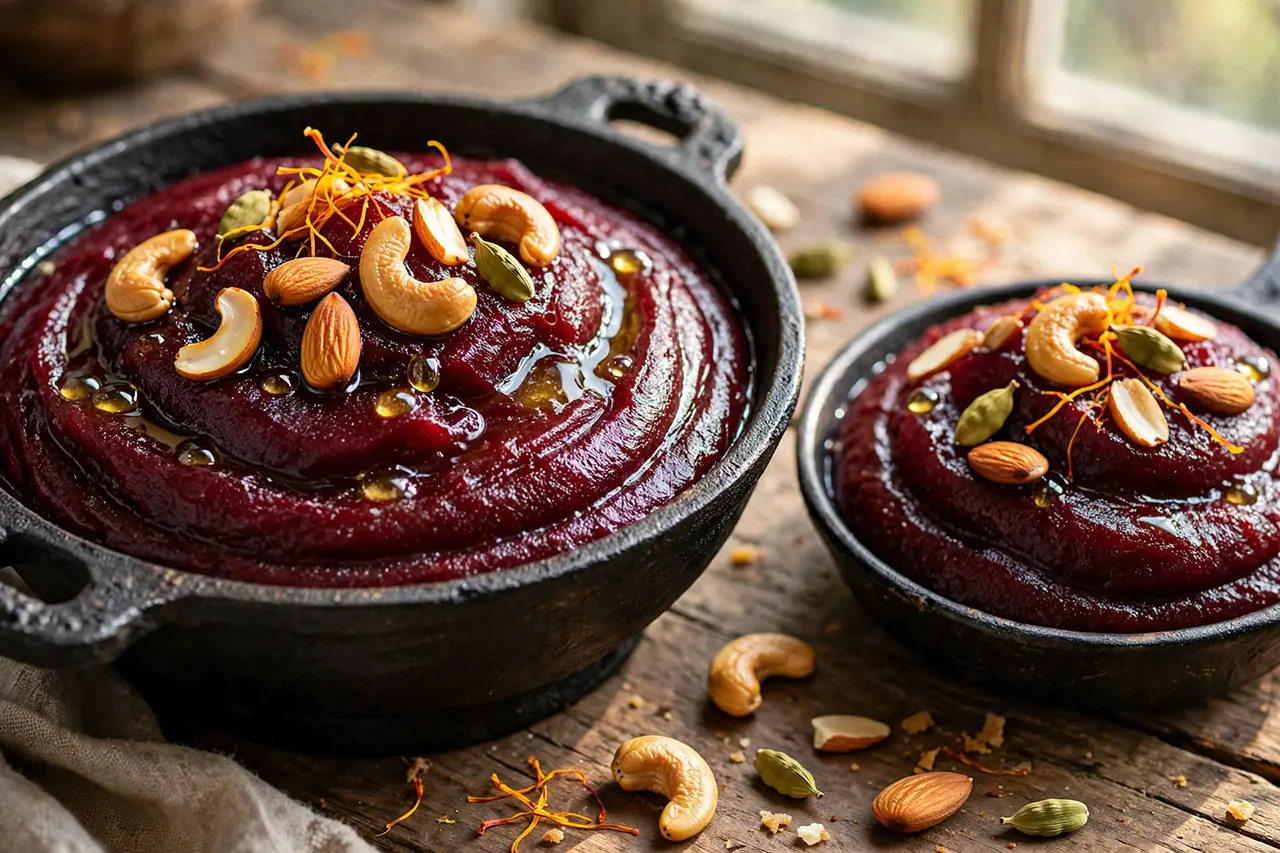
Rich, fragrant, and glossy, traditional beetroot halwa recipe (chukandar ka halwa) transforms firm, earthy winter roots into a luxurious Indian pudding with a fudgy, melt-in-the-mouth crumb.
What is Beetroot Halwa?
Beetroot halwa is a classic slow-cooked Indian dessert made by simmering finely grated beets in whole milk and ghee until reduced into tender, caramelized milk solids (mawa), then sweetened and perfumed with green cardamom. This kitchen-tested method relies on a preliminary ghee roast that neutralizes the root’s earthy compound (geosmin), followed by a controlled milk reduction that guarantees a rich, fudge-like consistency without curdling.
Key Ingredients & Their Culinary Mechanics
Every component in this recipe balances texture, fat emulsification, and sweetness:
- Fresh Beetroots (Medium, Firm): Choose heavy, smooth-skinned beets without deep fissures. Coarsely grating them yields distinct, chewy shreds; grating too finely causes the halwa to collapse into baby puree.
- Full-Cream Whole Milk: The foundation of authentic halwa. As the 1.5 liters of milk simmer, the water evaporates, leaving behind natural milk fats and solids (khoya/mawa) that coat the vegetable strands.
- Pure Desi Ghee: Essential for two distinct phases: first, to sauté the raw grated shreds and volatilize geosmin; second, to fry the reduced milk solids at the finish, delivering gloss and shelf stability.
- Granulated White Sugar: Sweetens and creates a glossy syrup glaze. Adding sugar draws remaining water from the beet tissue via osmosis, requiring a final evaporation phase.
- Green Cardamom Powder & Saffron: Cardamom provides top-note floral warmth that cuts through heavy dairy fat, while saffron blooms in hot milk to add subtle honeyed undertones.
- Cashews & Almonds: Toasted in ghee to provide a crisp texture contrast against the velvety pudding.
Equipment Needed
- Heavy-bottomed Kadai, Dutch Oven, or Deep Cast-Iron Pan: Essential to distribute heat evenly and prevent the milk solids from scorching during the 40-minute reduction.
- Box Grater (Medium Gauge): Creates uniform 2 mm shreds that retain bite.
- Heat-Resistant Silicone Spatula or Flat Wooden Spoon: Needed to scrape condensed milk solids continuously off the sides and base of the pan.
Step-by-Step Cooking of Beetroot Halwa Recipe
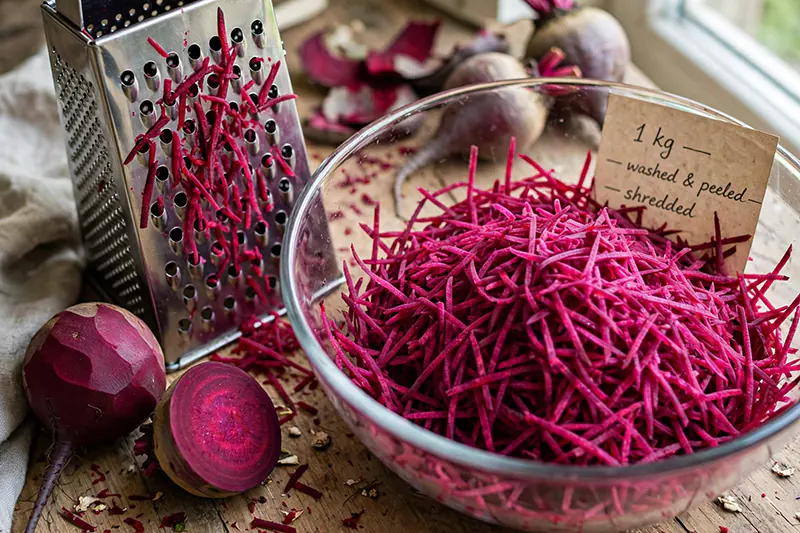
1. Prep and Shred the Beets: Avoid grating too finely to preserve texture.
Thoroughly wash and peel 1 kg of fresh beetroots. Using the medium teardrop holes of a standard box grater, grate the beets into uniform strands. Keep the shreds loose in a large bowl; do not squeeze out the juice.
2. Sauté Beets in Ghee: Crucial: Neutralizes earthy geosmin aromas.
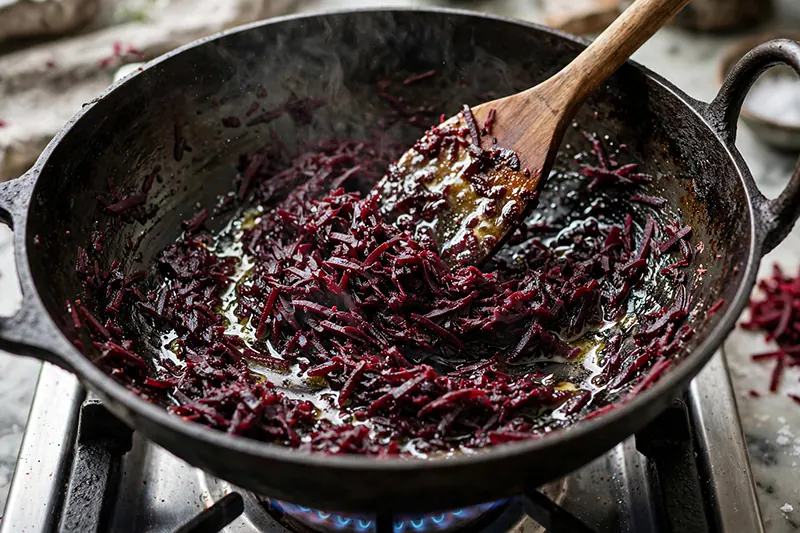
Set a heavy-bottomed kadai over medium heat and melt 2 tablespoons of ghee. Add the grated beets. Sauté continuously for 6 to 8 minutes.
Sensory Cue: The raw, muddy aroma transitions into a sweet, vegetal fragrance, and the vibrant purple-red strands darken slightly and wilt to approximately 75% of their initial volume.
Common Mistake: Skipping this step and adding milk immediately traps volatile earthy compounds inside the dairy emulsion.
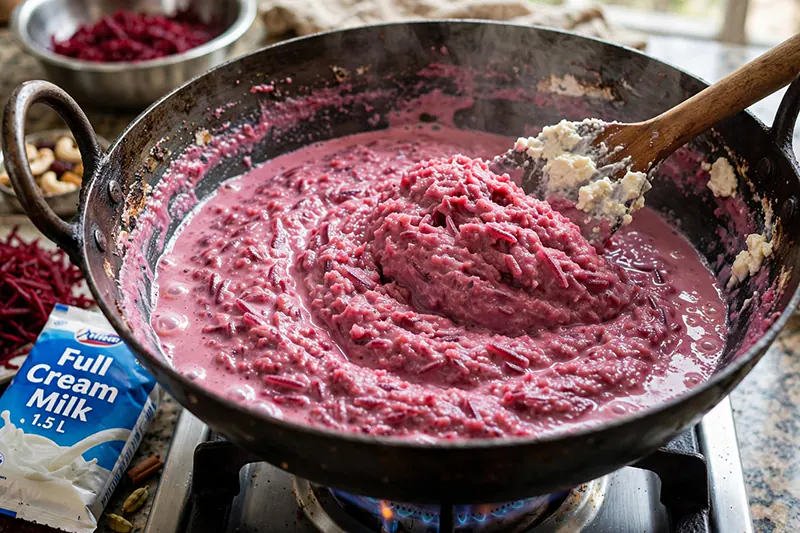
3. Simmer with Whole Milk: Scrape sides regularly to incorporate milk solids.
Pour 1.5 liters of warm full-cream milk directly over the sautéed beets. Stir well and bring the mixture to a rolling boil over medium-high heat. Once boiling, drop the heat to medium-low.
Allow the mixture to simmer uncovered for 30 to 35 minutes, stirring every 3 to 4 minutes and scraping the milk skin (malai) off the pan walls back into the center.
Sensory Cue: The liquid steadily drops from a soupy pink broth to a thick, porridge-like consistency. You are ready for the next step when you draw a spatula through the center of the pan and no pool of free liquid immediately floods the wake.
Common Mistake: Leaving the heat unattended on high causes milk solids to burn on the bottom, imparting a bitter, burnt taste throughout the dessert.
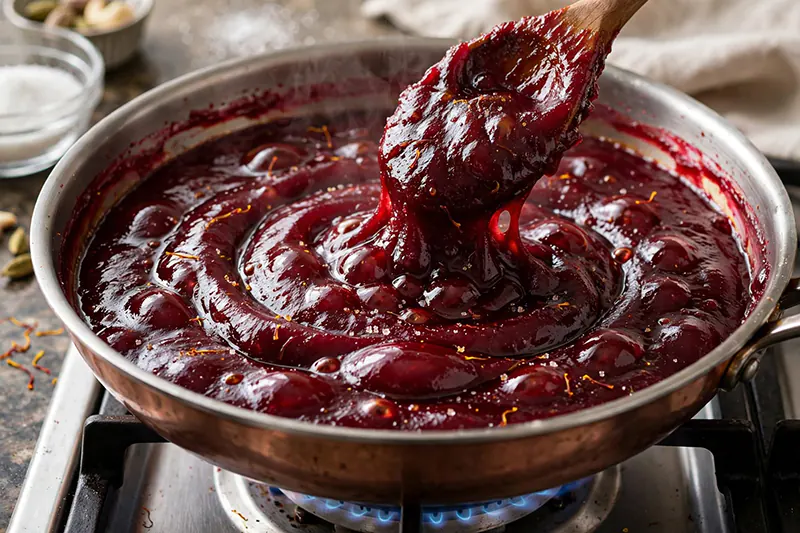
4. Sweeten and Dissolve: Expect the mixture to loosen temporarily as sugar draws water.
Add 350 to 400 grams of granulated sugar and a pinch of crushed saffron strands. Stir continuously over medium heat.
As the sugar melts, the mixture will liquefy and turn glossy. Continue cooking for another 8 to 10 minutes until the released water completely evaporates.
Sensory Cue: The halwa thickens back up, darkening from a soft magenta to a deep, lustrous ruby-maroon. Thick bubbles erupt slowly rather than boiling rapidly.
Common Mistake: Adding sugar at the start of cooking toughens the vegetable pectin and prevents the beet shreds from becoming tender.
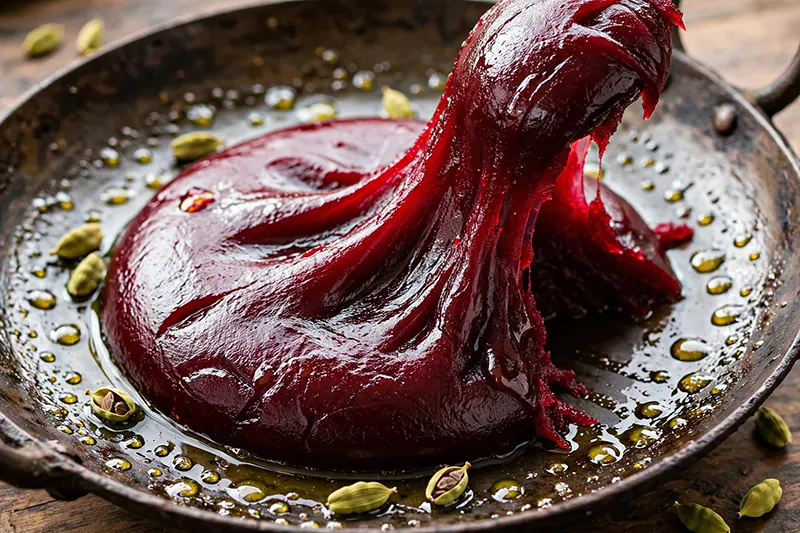
5. The Final Bhunao (Ghee Roasting): Develops rich caramelization and pan release.
Add the remaining 2 tablespoons of ghee and 1/2 teaspoon of freshly ground green cardamom powder. Stir vigorously over medium-low heat for 5 to 7 minutes.
Sensory Cue: The halwa coalesces into a single glossy mass that pulls cleanly away from the pan bottom without sticking. Tiny droplets of clear ghee glisten around the edges of the mass.
Common Mistake: Taking the pan off the heat while the bottom is still wet produces a soggy halwa that leaks liquid upon cooling.
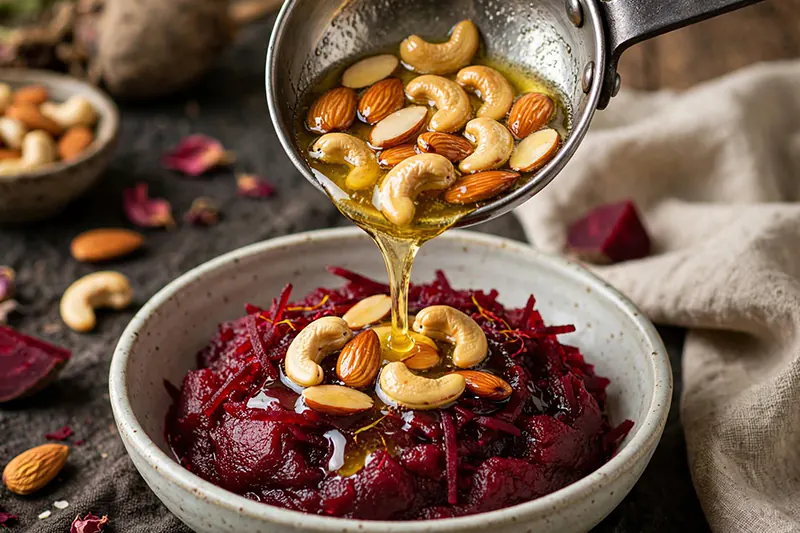
6. Fry Nuts and Garnish: Timing: 2 minutes.
In a small tadka pan over low heat, warm 1 teaspoon of ghee. Fry 15 halved cashews and 10 sliced almonds until pale golden and fragrant (about 90 seconds). Pour the warm nuts and ghee directly over the finished halwa. Fold through gently before serving.
Pro-Kitchen Tips for Texture and Flavor
- Never Use Skim or 2% Milk: Authentic halwa relies on milk fat solids settling onto the vegetable fibers. Reduced-fat milk creates excess steam without depositing the essential buttery curd layer, leaving the halwa watery and flat.
- Add Saffron Early in the Dairy Phase: Adding saffron threads directly to the hot milk during Step 3 allows the carotenoid pigments and aromas to infuse the entire halwa matrix rather than sitting on top.
- Warm the Milk Before Adding: Adding cold, straight-from-the-fridge milk to hot sautéed beets creates thermal shock that can trigger curdling if the beets have slightly higher acidity. Always bring milk to room temperature or heat until lukewarm.
- Use Freshly Cracked Green Cardamom: Pre-ground store-bought cardamom powder loses its volatile terpenes quickly. Pound whole green cardamom pods in a mortar just before finishing the dish for maximum citrus-floral brightness.
Troubleshooting Common Halwa Failures
| Issue | Root Cause | Exact Solution |
| Milk Curdled into Tiny Specks | High beet acidity, cold milk shock, or high heat reduction. | Do not discard. Keep stirring over low heat; as the liquid evaporates, the separated curds consolidate into sweet chenna/khoya granules that enrich the texture. |
| Halwa is Watery After Adding Sugar | Sugar draws out trapped cellular moisture via osmosis. | Raise heat to medium-high and stir constantly for 6–8 minutes until liquid evaporates completely and the mass releases oil. |
| Strong Raw/Earthy Aftertaste | Grated beets were not sautéed sufficiently in ghee before dairy was added. | Melt 1 tbsp ghee in a clean skillet, add the halwa, and roast over low heat for 8–10 minutes with an extra 1/4 tsp cardamom powder. |
| Texture is Mushy / Pureed | Fine grating or pureeing in a food processor blade. | Always use the medium/large hole box grater to ensure distinct ribbons that withstand prolonged boiling. |
Storage, Shelf Life, and Reheating
- Refrigeration: Cool the halwa completely to room temperature. Transfer to an airtight glass container and store in the refrigerator for up to 7 days. The ghee will solidify, giving the cold halwa a dense, fudgelike bite.
- Freezing: Beetroot halwa freezes exceptionally well. Portion into freezer-safe containers for up to 3 months. Thaw overnight in the refrigerator before reheating.
- Reheating Instructions:
- Stovetop (Recommended): Place halwa in a skillet over low heat. Add 1 teaspoon of milk or ghee to restore sheen. Stir gently for 3–4 minutes until hot and aromatic.
- Microwave: Heat in 30-second bursts at 80% power, stirring between intervals to prevent the sugars from scorching at the bowl edges.
If you love rich vegetable-based sweets, this pairs naturally on a festival dessert platter alongside traditional carrot halwa (gajar ka halwa), which uses the exact same milk-reduction technique. For a full celebration spread, balance the deep sweetness of this halwa with a crisp, savory bite like aloo samosas or ulundu vadai, or contrast its warm cardamom notes with a cooling scoop of kesar pista kulfi.
Authentic Variations
- Quick Condensed Milk Method: Replace the 1.5 L whole milk and sugar with 1 tin (400 g) sweetened condensed milk plus 1 cup whole milk. Sauté beets in ghee, simmer in 1 cup milk for 10 minutes until tender, then stir in condensed milk and cook for 10 minutes until thick.
- Khoya / Mawa Enriched: Reduce whole milk to 500 ml. At Step 5, crumble in 150 grams of fresh unsweetened mawa (milk fudge) alongside the sugar. This cuts cooking time by half while adding a dense, celebratory halwai-style texture.
- Vegan Beetroot Halwa: Substitute dairy milk with thick, culinary-grade coconut milk or cashew cream, and swap desi ghee with cold-pressed coconut oil. The subtle nutty sweetness pairs naturally with beets.
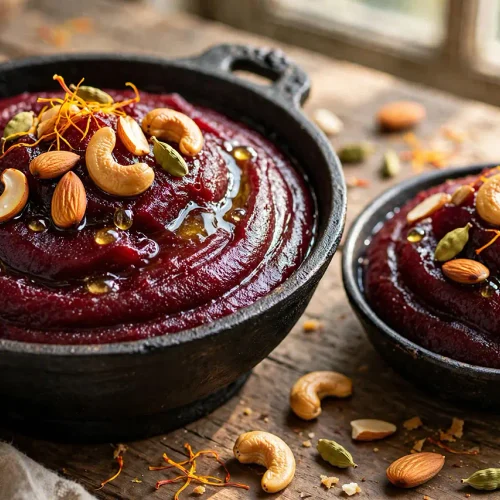
Traditional Beetroot Halwa (Chukandar Ka Halwa)
An authentic, rich Indian dessert recipe made by slow-cooking grated beetroots in full-cream milk, ghee, and cardamom until velvety and glossy.
Ingredients
- 1 kg fresh beetroots peeled and coarsely grated (approx. 5 cups packed)
- 1.5 liters full-cream whole milk warm
- 350 grams granulated white sugar approx. 1 ¾ cups; adjust between 300–400g based on beet sweetness
- 4 tablespoons pure desi ghee divided: 2 tbsp + 2 tbsp + 1 tsp
- ½ teaspoon freshly ground green cardamom powder
- 1 generous pinch saffron strands approx. 15–20 strands
- 15 whole raw cashews split in halves
- 10 whole raw almonds slivered
Instructions
- Sauté Beets: Melt 2 tbsp ghee in a heavy-bottomed kadai over medium heat. Add 1 kg grated beetroot and sauté for 6–8 minutes until softened and sweet-smelling.
- Simmer with Milk: Pour in 1.5 L warm whole milk. Bring to a boil, reduce to medium-low, and simmer uncovered for 30–35 minutes, stirring frequently until the liquid has evaporated.
- Sweeten: Add 350 g sugar and saffron strands. Cook over medium heat for 8–10 minutes as the sugar melts and the excess liquid simmers away.
- Bhunao (Pan-Fry): Stir in the remaining 2 tbsp ghee and ½ tsp cardamom powder. Cook for 5–7 minutes, stirring vigorously until the halwa pulls away cleanly from the sides of the pan.
- Garnish & Serve: Heat 1 tsp ghee in a small pan, toast the cashews and almonds until golden, and fold them into the warm halwa. Serve warm or chilled.