Best Modak Recipe | Steamed Modak Recipe with Jaggery
Modak Recipe: As soon as I shut my eyes and remember, there comes a gush of memories. It’s not just a sweet dumpling for me; it’s a childhood flavor, a reminder of dedication, and a connection to my heritage. I recall my grandmother, her hands colored with turmeric and a smile that lit her face, carefully molding each Modak with love that you could taste as you ate it.
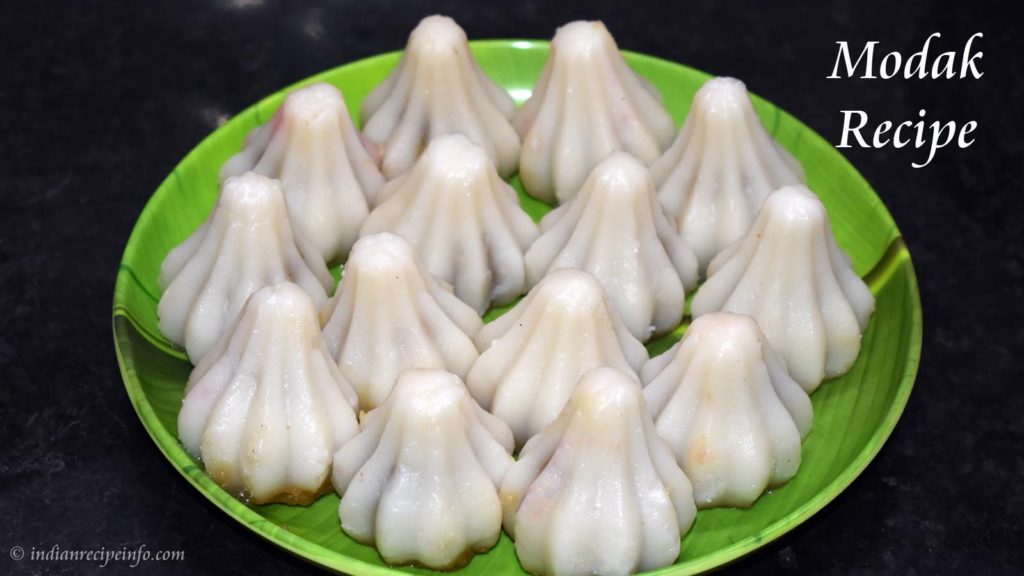
The fragrance of freshly steamed Modak used to pervade our house, announcing the onset of the Ganesha festival, a season of celebration, feasting, and bonding. This Modak recipe is not merely a list of instructions; it is a family tradition that has been passed on from generations, and I feel privileged to pass it along to you.
For several, Modak will instantly bring to mind Lord Ganesha, the elephant-headed god who is said to have a special liking for the sweet dish. Preparing Modak is a labor of love and devotion, a means to connect with the divine and honor a rich culture. Though there are numerous variations of this traditional dish, the steamed Modak, or Ukadiche Modak, remains a favorite in many’s hearts. The delicate, soft rice flour wrapper covering a sweet, aromatic filling of coconut and jaggery is an experience divine.
This article is your guide to mastering the art of making the best Steamed Modak recipe. Whether you are an experienced cook or a novice in the kitchen, I’ll guide you through every step, revealing the secrets I’ve discovered over the years to make your Modak turn out perfectly each time. From choosing the right ingredients to the art of making perfect pleats, we’ll discuss it all. So, let’s get our sleeves rolled up and start this tasty adventure. This is my tried and tested Modak recipe, and I am so excited for you to give it a go.
The Magic of the Ingredients: Why Each One Matters
Before we dive into the recipe, let’s talk about the ingredients. Every ingredient in this Modak recipe plays a crucial role in creating the perfect texture, flavor, and aroma. Understanding their purpose will elevate your cooking from simply following instructions to truly creating a masterpiece.
Rice flour (1 bowl): The base of our Modak. A high-quality, fine rice flour is the key to a smooth and workable dough. It provides the outer covering with its characteristic soft and slightly chewy texture. A good quality rice flour prevents the dough from cracking while shaping, and that is critical for a handsome Modak.
Water (Needed): The underappreciated workhorse. An adequate amount of water, properly heated to the proper temperature, is vital to producing a perfect dough. It activates the starches in the rice flour to yield a soft, pliable dough easy to work with. Too little water and it will be crumbly, dry; too much will make it sticky, unmanageable.
Salt (1/2 tbsp.): A small amount of salt may not look like much, but it’s a flavoring agent. It counteracts the sweetness of the filling and highlights the delicate nutty taste of the rice flour. It’s the key to an equilibrated and tasty Modak. It’s an important component in our Modak recipe.
Sugar (2 tbsp.): Although most of the sweetness is from the filling, a bit of sugar in the dough contributes towards making a stunning, smooth finish and a hint of sweetness that balances with the richness of the filling. It also aids in a glossy finish to the steamed Modak.
Ghee (1 tbsp.): The aromatic powerhouse. Ghee not only adds a rich, nutty flavor to the dough but also makes it incredibly soft and pliable. It prevents the dough from sticking to your hands and the steaming plate, ensuring a clean and perfect Modak. A little ghee in the filling also adds a wonderful richness and aroma.
Fresh coconut grate (1 bowl): The soul of our Modak. Fresh coconut is not an option for a traditional and tasty Modak. It has a natural sweetness, a great texture, and an unbeatable aroma. The filling is what makes this Steamed Modak recipe stand out.
The Importance of Special Spices
An ordinary Modak recipe can be transformed into an exceptional one with the inclusion of some special spices. They are not only used for taste; they also carry cultural importance and health benefits.
Cardamom powder (Elaichi): The showstopper. Cardamom contributes a sweet, warm, and slightly floral fragrance to the filling. It’s a common ingredient in Indian sweets and is used for its digestible properties. A good-sized pinch of freshly ground cardamom powder will make your Modak irresistible. A cardinal ingredient in any authentic Modak recipe.
Nutmeg (Jaiphal): Only a small pinch of grated nutmeg provides a warm, woody, and slightly spicy flavor to the filling. It goes wonderfully with cardamom and coconut, providing yet another depth to the flavor. Use it sparingly since a little is enough.
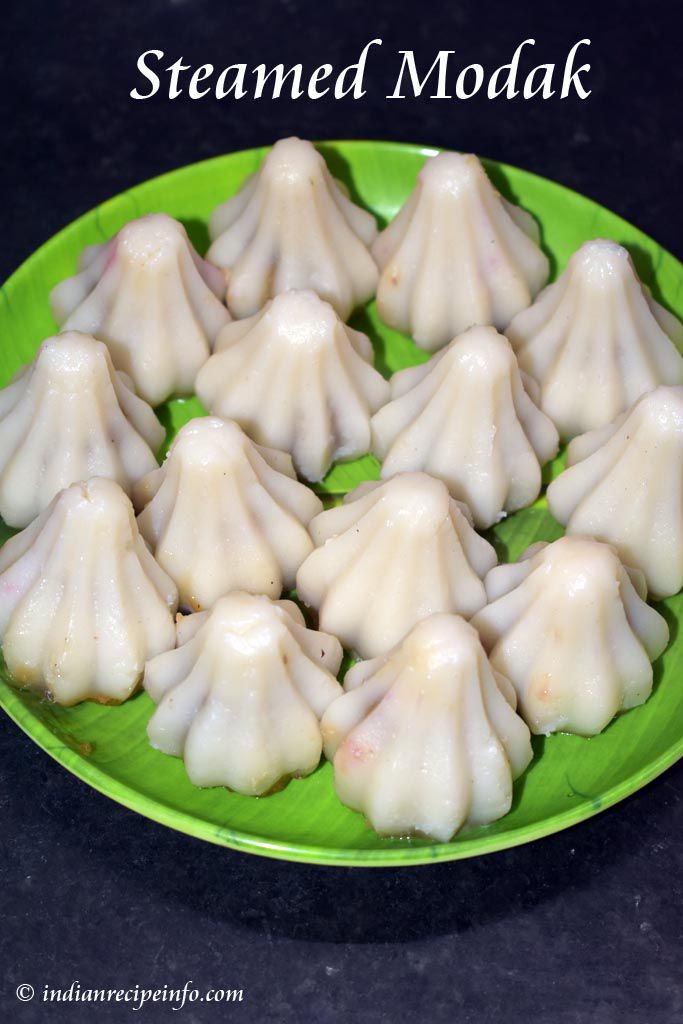
You may like to check other recipes:
Boondi Laddu and
How to make Modak Recipe:
Preparing Soft and Crack free dough for filling:
1. Pour 1 bowl of water into a pan and add a little salt, sugar and ghee. Mix well.
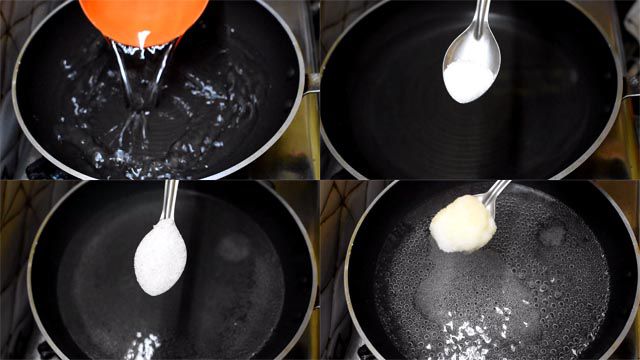
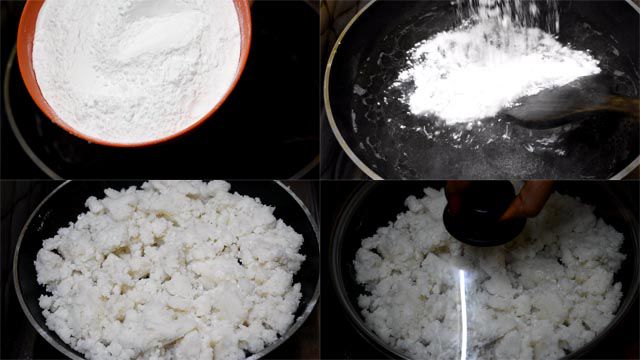
2. Put rice flour in small batches and stir well so that lumps are not formed. Cover the pan with a lid and keep it aside so that the flour absorbs moisture and becomes soft.
Preparing Sweet Stuff:
3. Put fresh coconut grate in a pan and sauté for a second.
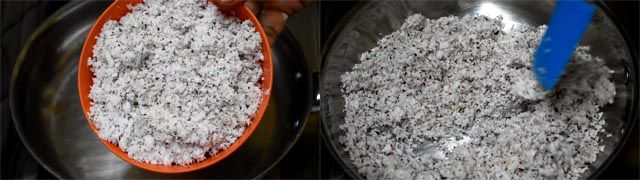
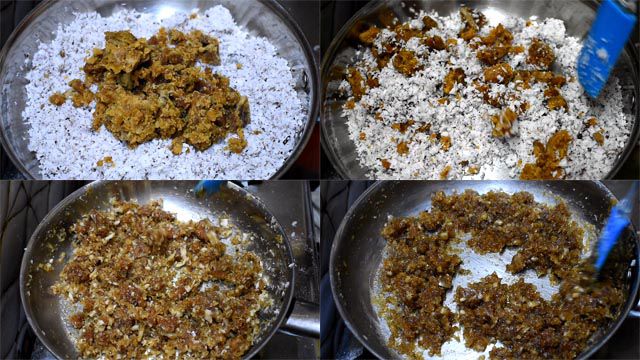
4. Add jaggery and stir for a while. Jaggery starts melting and it bonds with coconut grate to form a thick paste.
5. Open the lid of the rice flour, apply a little hot water and start kneading rice flour to get a soft pliable dough.
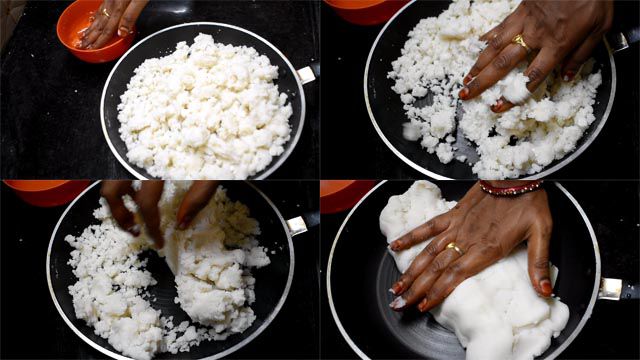
Shaping Modak Recipe:
6. Apply a little ghee and grease the modak mold so that we get non-sticky Modak Recipes.

7. Take a small portion of dough and put it in a modak mold. Press on all sides so that the dough takes the shape of the mould keeping a hollow space in the center.
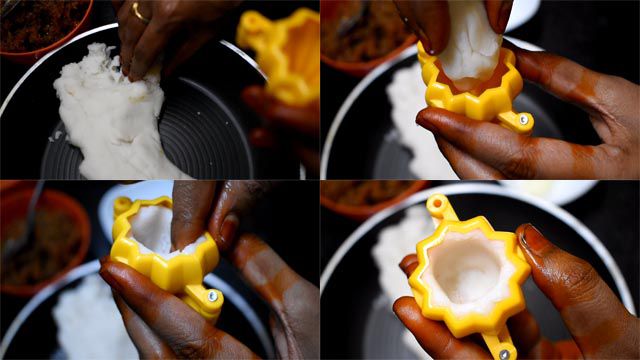
8. Put a small portion of jaggery coconut mix in modak and seal the bottom with dough so that it doesn’t slip while cooking.
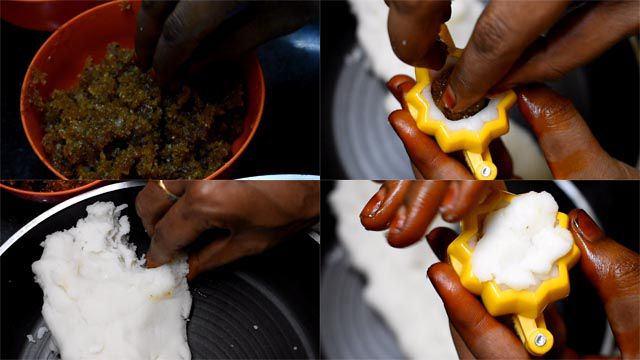
9. Remove the lock and gently remove the modak from the mould and keep aside.
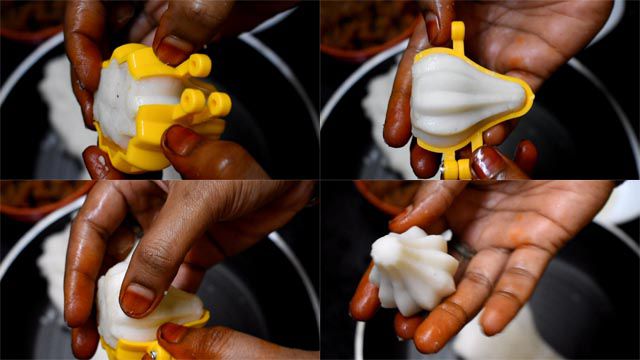
Steaming the Modakalu:
10. In a wide vessel pour a little water and a colander basket and put one by one modaks and cover with a lid.
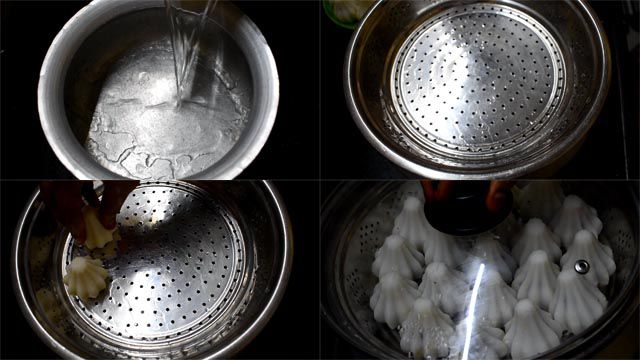
11. Cook Modakalu on low to medium flame for 15 minutes.
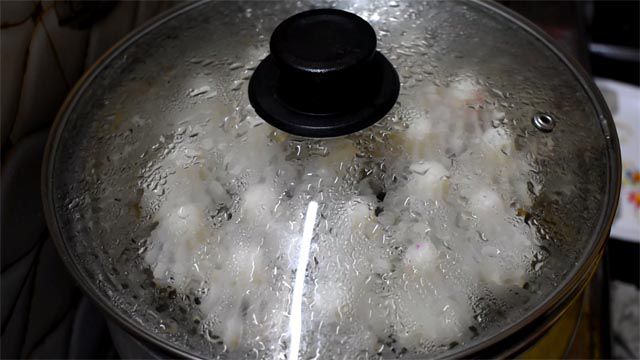
12. Serve Modak Recipes as Naivedyam or Prasadam to Lord Ganesh.
Watch the Steamed Modak Recipe Video on >> YouTube.
TIPS to make Perfect Modak Recipe:
- The ratio of dough and water plays an important role in making this recipe. We need to use 1:1 ratio of water and rice flour.
- To avoid crack while making this recipe we need to cook and make sure that there are no lumps while adding rice flour.
- Once rice flour is cooked, keep it aside for 5 to 10 minutes so that the flour absorbs moisture and becomes soft.
- If you feel the dough is hard, wet your hands with hot water while kneading.
- Either place the lid over the dough or place a wet cloth to avoid cracks due to drying.
- By accident, if you sprinkle more water, the dough may become sticky to overcome this issue, add a little rice flour. If you stick to 1:1 ratio you will not have this issue.
- While making coconut and jaggery mix, cook till both ingredients become dry so that while steaming you will not notice liquid leakage.
- As we cook Modak Recipe over steam, it’s a good idea to close the opening properly, or else sweet may come out.
- Rice flour can be purchased in the market or else we can make it ourselves by grinding and sieving flour to a soft powder. Fine flour gives you soft and crack-free moulds.
- While using coconut, use fresh grate and fry for a minute to give a non-sticky and less juicy mix.
- Jaggery is available in different qualities, avoid salt. If you feel there are dust particles melt jaggery and filter dust particles. Try to use a branded quality.
Notes
- Kneading is key: The quality of your Modak dough depends heavily on how well you knead it. A well-kneaded dough will be smooth, crack-free, and easy to shape.
- Don’t overfill: Overfilling the Modak will make it burst in the steam. Fill it with just enough filling to close the Modak tightly.
- Fresh is best: To experience the most authentic and divine taste, use fresh grated coconut only. The flavor of a Steamed Modak recipe made with fresh coconut is unsurpassable.
- Test your dough: Take a small sample of dough and roll it into a ball before you begin to shape. If it doesn’t crack, your dough is ready to go. If it does crack, knead it for another few minutes.
Storing and Reheating Leftovers
Modaks are best served fresh, but if you have leftovers, they can be stored.
Storage: Keep the cooled Modaks in an air-tight container and refrigerate them for a maximum of 3-4 days.
Reheating: To reheat, you can steam them again for 5-7 minutes. This will restore their softness and fresh-from-steaming texture. Microwaving should be avoided because it will make the Modaks hard and chewy.
Complementary Dishes and Beverages
Modak can be served as a dessert on its own, but it goes well with some foods and drinks.
- Side dishes: Traditional Maharashtrian Thali usually consists of Modaks with some savory items such as Puri Bhaji or Dal Khichdi. Sweet and savory contrast is wonderful.
- Drinks: A glass of hot masala chai or a saffron milk (kesar doodh) would be an ideal accompaniment to the sweetness of the Modak.
The Modak Journey: A Gourmet Delve
The Modak recipe is more than just ingredients; it is a tale. The name Modak itself is derived from the Sanskrit name modaka, which is a “giver of joy.” And sure enough, it gives great joy to those who cook and consume it. This sweet dumpling also has an interesting history, dating back to ancient India. The steamed one, Ukadiche Modak, is a Konkan specialty of Maharashtra and is the authentic offering to Lord Ganesha.
The delicate pleats of the Modak are said to symbolize the folds of a lotus flower, representing divine beauty and purity. The process of moulding the Modak is meditation in itself, channeling one’s energy and love into the food. This Modak recipe is a great way to experience this rich tradition and heritage.
The outer covering, or ukad, of rice flour is the ultimate demonstration of Indian cuisine’s elegance and economy. Rice, the region’s staple grain, is cleverly converted into a dainty and soft outer shell that beautifully encases the rich filling. The filling, a mixture of fresh coconut and jaggery, is a joyous expression of the region’s bountiful natural produce. This straightforward mix yields a sweetness, earthiness, and intensely gratifying taste.
FAQ Section: Your Questions Answered
Q: Can I use dried coconut instead of fresh?
A: You can, but the taste and texture won’t be the same. Grated coconut fresh is the secret to a true and tasty Steamed Modak recipe. If you have to use dry, soak it in warm water or milk for 30 minutes before use.
Q: My dough is cracking when shaping. What do I do?
A: This indicates your dough is either too dry or under-kneaded. Add one tablespoon of hot water to the dough and knead it again until smooth and pliable. Well-kneaded dough is the key to a great Modak recipe.
Q: How do I know the filling is ready?
A: The filling is done when it begins to hold together and becomes soft when you press it with your finger. It must be firm but not dry. A test is to take a little bit and roll it into a ball without it breaking apart.
Q: Can I substitute sugar for jaggery?
A: You can use it, yes. But jaggery imparts a caramel-like taste to the filling and gives it a darker color. If you’re using sugar, the filling will be pale and have a different taste, but otherwise delicious.
Q: My Modaks are sticking to the steamer plate. What am I doing wrong?
A: Grease the steamer plate generously with ghee and place the Modak on it. Make sure to keep the Modak not touching each other while steaming.
Nutritional Information (per Modak, approximate)
- Calories: 150-180 kcal
- Carbohydrates: 25-30g
- Fat: 5-7g
- Protein: 2-3g
- Fiber: 1-2g
Please bear in mind that these values are approximate and can be different based on the size of the Modak and the precise ingredients used in this Modak recipe.
Serving Suggestions
Modaks are usually served hot, sprinkled with a small amount of ghee. Modaks are commonly used in a celebration spread, but they can also be a great evening snack or a splurge dessert. Serve them along with a saffron milk side for a regal feel. Steamed Modak recipe is the best way to celebrate any celebration.
The process of creating a Modak is a satisfying one. From the very first knead of the dough to the very first bite of the soft, sweet dumpling, it’s a love-filled experience, one steeped in tradition and saturated with flavor. This Modak recipe is proof of the beauty of simplicity and the strength of food to unite people. I hope this tutorial assists you in making your own perfect Modaks and that you enjoy sharing them with your loved ones and making new memories that will last a lifetime. Happy cooking! This is my favorite recipe for Modaks, and I hope that it becomes one for you as well.
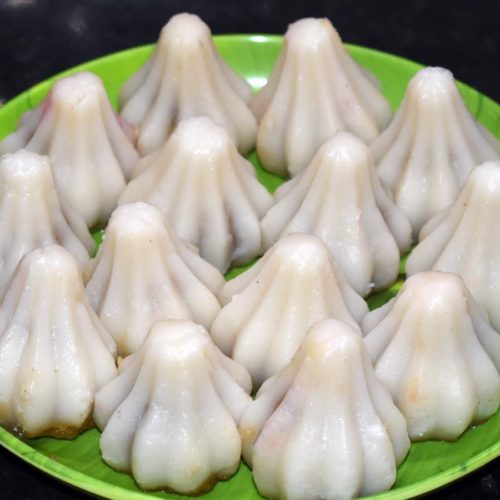
Modak Recipe | Modakalu | How to make Steamed Modak Recipe
ModakRecipe is one of the favourite recipes of Lord Ganesh. They are made using rice flour batter filled with coconut jaggery mix. Learn how to make this recipe with step by step image instructions along with tips.
Ingredients
- Rice flour – 1 bowl
- Water – Required
- Salt – ½ tbsp.
- Sugar – 2 tbsp.
- Ghee – 1 tbsp.
- Fresh coconut grate – 1 bowl
Instructions
- Boil water in a vessel by adding 1 cup water, add little ghee, salt and sugar to make dough soft and crack free.
- Lower the flame so that steam doesn’t burn your hand, put rice flour in small batches and stir continuously.
- Make sure that there are no lumps. Stir continuously till you get a thick batter.
- Remove from the flame and put a lid over it and keep aside for 5-10 minutes so that flour becomes soft by absorbing moisture.
- In a pan, add fresh coconut grate and stir fry for a second so that moisture is cooked.
- Add jaggery powder or chunks and cook still it bonds with coconut and becomes dry.
- Open the lid of dough and knead to the soft dough while it’s mild hot.
- If you feel it’s hard, then sprinkle little hot water and knead for a minute.
- Divide dough into small portions if you are making with hands or else take a small quantity of dough based on the size of modak mould.
- Grease modak mould with ghee and put a small portion of dough and press to take its shape and there is a place in the center to fill with sweet.
- Take a small quantity of coconut jaggery sweet mix (we can substitute with khoa) and seal the bottom with dough properly.
- Gently remove modak recipe and place over a plate and cover with a cloth so that moisture is locked.
- Take a wide vessel and add little water and place colander basket (or idli jar) and put modaks over it and cover with a lid.
- Steam cook for 15 minutes like idli recipe.
- Offer Modak Recipes along with other Prasad to Lord Ganesh and take the blessing of Lord.


2 Comments