Authentic Bitter Gourd Pitlai Recipe (Pavakkai Pitlai)
Bitter Gourd Pitlai (known as Pagarkkai Pitlai or Pavakkai Pitlai in Tamil) is a traditional South Indian lentil stew made with tender bitter gourd, protein-rich toor dal, tangy tamarind extract, and a freshly roasted, aromatic spice-and-coconut paste. Balanced with a small piece of jaggery, it delivers an earthy, complex balance of bitter, tangy, spicy, and mildly sweet notes that pairs over hot steamed rice with a drizzle of ghee.
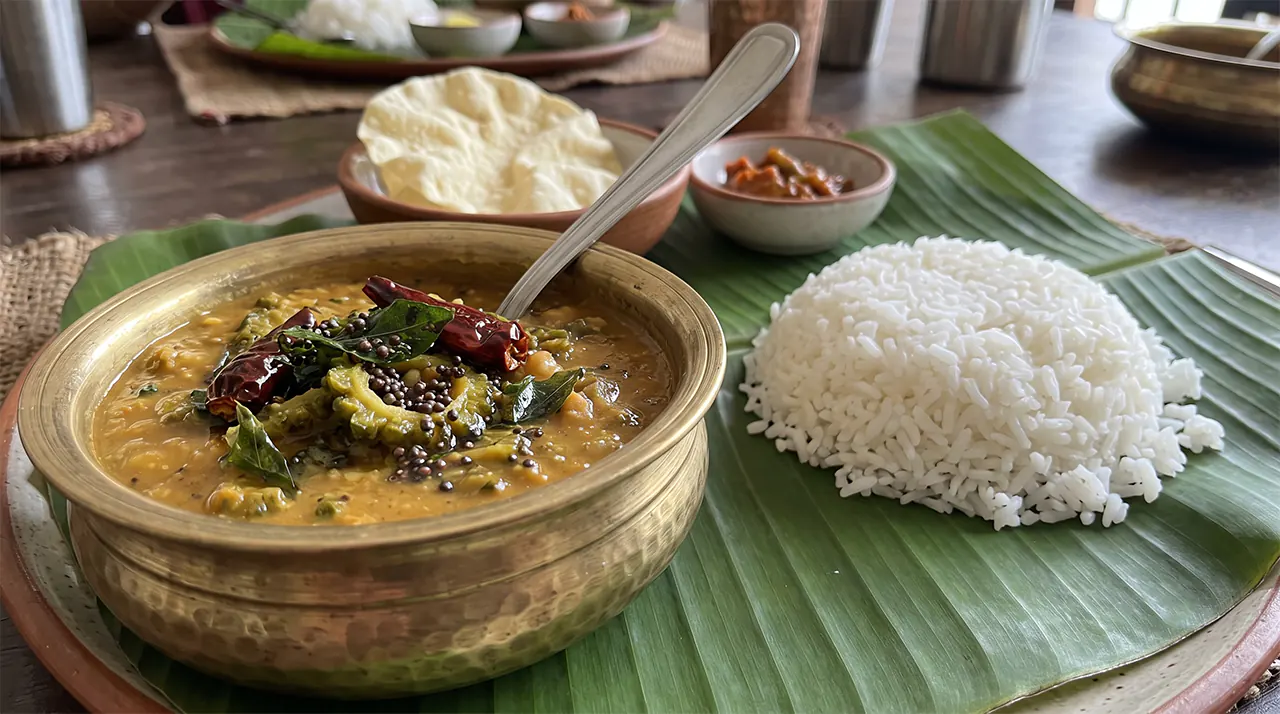
If you have family members who usually avoid karela, this classic Thanjavur and Tamil Brahmin preparation is one of the most effective ways to cook it. The acidity of the tamarind and the deep, roasted notes of coriander, chana dal, black pepper, and toasted coconut naturally round out the vegetable’s sharpness.
What Makes Pitlai Different From Sambar?
While both dishes use a toor dal and tamarind base, pitlai differs in four distinct ways:
- Darker, Pepper-Forward Spice Paste: Sambar typically relies on dried red chillies and coriander seeds. Pitlai incorporates whole black peppercorns and roasted chana dal alongside fresh coconut, yielding a deeper, woodsy heat.
- Toasted Coconut Base: In pitlai, grated coconut is roasted in oil until deep golden brown before grinding, creating a toasted aroma distinct from raw-ground arachuvitta sambar.
- Thicker Consistency: Pitlai is noticeably thicker than daily sambar, coats the back of a spoon, and behaves more like a hearty stew.
- Traditional Inclusion of Legumes: Pitlai often pairs bitter gourd with boiled black chickpeas (konda kadalai), introducing a firm, nutty contrast to the tender vegetable slices.
Ingredients You Will Need
1. For Cooking the Lentils & Vegetables
- Bitter Gourd (Pavakkai / Karela): 2 medium (approx. 200g), washed, deseeded, and sliced into 1/2-inch semi-circles.
- Toor Dal (Tuvaram Paruppu): 1/2 cup (raw), rinsed thoroughly.
- Water: 1.5 cups (for pressure cooking dal) + 1.5 cups (for boiling vegetable).
- Turmeric Powder: 1/2 tsp (divided into two 1/4 tsp portions).
- Tamarind: 1 small lemon-sized ball (soaked in 1 cup warm water) or 1.5 tbsp thick tamarind paste.
- Jaggery (Powdered or Crushed): 1 tsp (adjust to taste).
- Rock Salt: 1 to 1.25 tsp (or to taste).
- Optional Addition: 1/3 cup boiled black chickpeas (konda kadalai).
2. For the Freshly Roasted Pitlai Masala Paste
- Sesame Oil (Gingelly Oil): 1 tsp.
- Chana Dal (Bengal Gram / Kadalai Paruppu): 1 tbsp.
- Coriander Seeds (Dhania): 1 tbsp.
- Whole Black Peppercorns: 1/2 tsp.
- Dried Red Chillies: 3 to 4 (use a mix of Guntur for heat and Kashmiri/Byadagi for rich color).
- Fresh Grated Coconut: 1/3 cup.
- Water for Grinding: 3 to 4 tbsp.
3. For the Tempering (Thadka)
- Sesame Oil (Gingelly Oil) or Ghee: 1 tbsp.
- Mustard Seeds (Kadugu): 1/2 tsp.
- Urad Dal (Ultham Paruppu): 1/2 tsp.
- Curry Leaves: 1 sprig (8–10 fresh leaves).
- Asafoetida (Hing): 1/4 tsp (powder).
Ingredient Notes & Smart Substitutions
- Bitter Gourd Selection: Pick medium-sized, firm, dark green gourds with closely spaced ridges. Large, pale gourds tend to be water-heavy, while yellowish gourds indicate over-ripeness and tough, bitter seeds.
- Sesame Oil (Gingelly Oil): Authentic South Indian pitlai relies on cold-pressed Indian sesame oil (nalla ennai). Do not substitute with toasted East Asian dark sesame oil; use peanut oil or sunflower oil if South Indian sesame oil is unavailable.
- Tamarind: Fresh whole tamarind soaked in warm water provides better balanced acidity than processed, bottled concentrates. If using commercial dark paste, start with 1 tablespoon and adjust to avoid harsh acidity.
- Chana Dal in the Paste: Do not skip the chana dal when roasting. It binds the gravy, acts as the primary thickener, and keeps the water and coconut from separating during the final simmer.
How to Prepare Bitter Gourd to Moderate Bitterness
If your household prefers a milder taste, use this traditional method before starting the main curry:
- Cut the bitter gourds in half lengthwise, scrape out the white pith and seeds with a spoon, and cut them into 1/2-inch semi-circles.
- Toss the cut slices with 1/2 teaspoon of salt and 1/4 teaspoon of turmeric powder in a bowl.
- Let it rest for 15 minutes. The salt draws out moisture containing bitter juices.
- Squeeze the slices gently between your palms to express the excess liquid, discard the liquid, and proceed with the recipe.
Step-by-Step Cooking Instructions
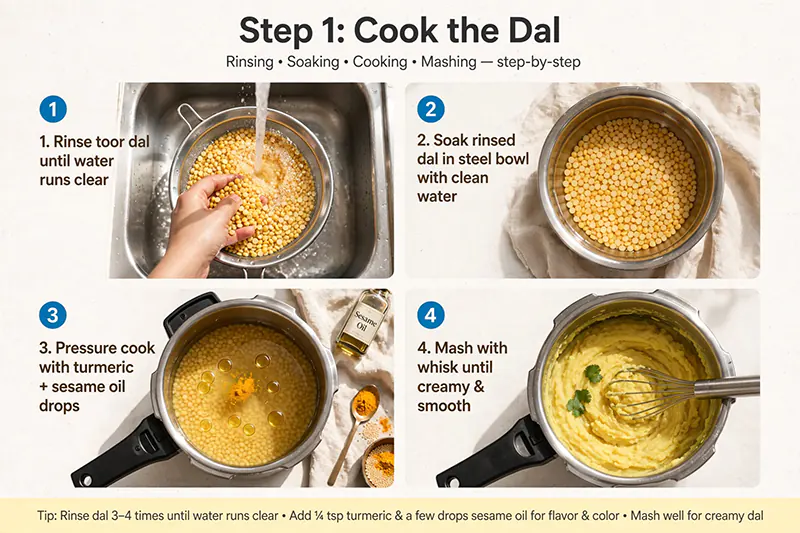
Step 1: Cook the Dal
- Rinse 1/2 cup of toor dal until the water runs clear.
- Add the dal to a pressure cooker with 1.5 cups of water, 1/4 tsp turmeric powder, and 2 drops of sesame oil.
- Pressure cook for 4 whistles on medium heat (or 8 minutes under high pressure in an electric cooker). Let the pressure release naturally.
- Open the lid and mash the dal thoroughly with a whisk or back of a ladle until smooth and creamy. Set aside.
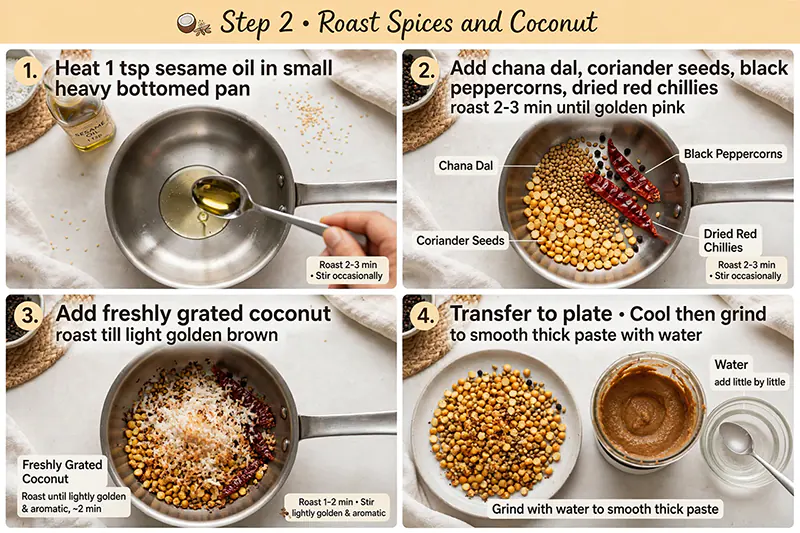
Step 2: Roast the Spices and Coconut
- Heat 1 tsp of sesame oil in a small heavy-bottomed pan over low-medium heat.
- Add 1 tbsp chana dal, 1 tbsp coriander seeds, 1/2 tsp black peppercorns, and 3–4 dried red chillies.
- Roast gently for 2 to 3 minutes, stirring constantly, until the chana dal turns golden-pink and fragrant. Do not let the chillies blacken.
- Add 1/3 cup of freshly grated coconut to the warm spices.
- Continue roasting on low heat for another 2 to 3 minutes until the coconut turns an even, light golden-brown color.
- Transfer the mixture to a plate and let it cool completely.
- Place the cooled ingredients into a small spice grinder jar with 3 to 4 tablespoons of water. Grind to a smooth, thick paste. Set aside.
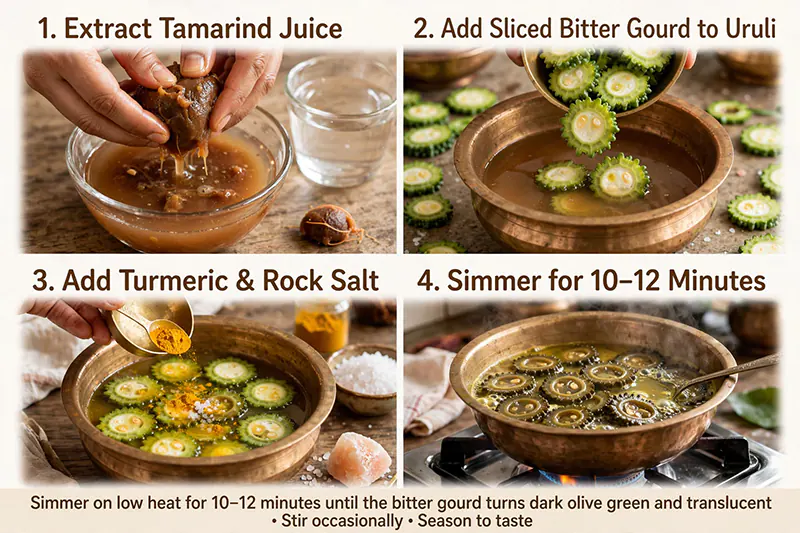
Step 3: Simmer Bitter Gourd in Tamarind Extract
- In a heavy-bottomed pot or traditional uruli, extract 1 cup of tamarind juice from the soaked tamarind ball using warm water (discard the fiber and seeds).
- Add the sliced bitter gourd to the pot along with the tamarind water, an additional 1/2 cup of plain water, 1/4 tsp turmeric powder, and 1 tsp rock salt.
- Bring to a boil over medium heat. Simmer uncovered for 10 to 12 minutes.
- Visual Cue: The bitter gourd slices are ready when they turn dark olive green, look slightly translucent, and yield easily when pierced with a fork. The raw, pungent smell of tamarind should completely disappear. (If you are using cooked black chickpeas, add them to the pot now).
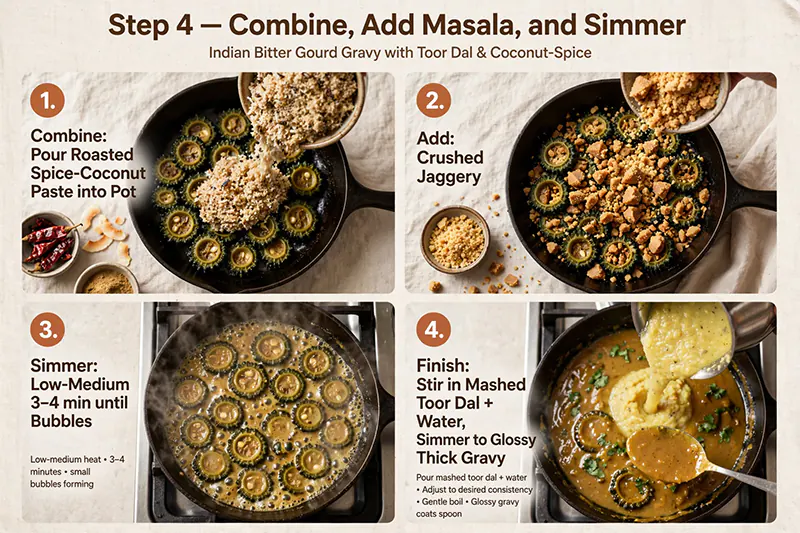
Step 4: Combine, Add Masala, and Simmer
- Pour the ground roasted spice-coconut paste into the pot with the cooked bitter gourd. Stir well to dissolve any clumps.
- Add 1 tsp of crushed jaggery.
- Simmer on low-medium heat for 3 to 4 minutes until the raw edge of the paste subsides and small bubbles break the surface.
- Pour in the mashed toor dal along with 1/2 cup of water to adjust consistency. Stir thoroughly.
- Bring the stew to a gentle boil on low heat for 4 to 5 minutes. The gravy will thicken as the roasted chana dal expands. Once glossy and coating the back of a spoon, turn off the heat.
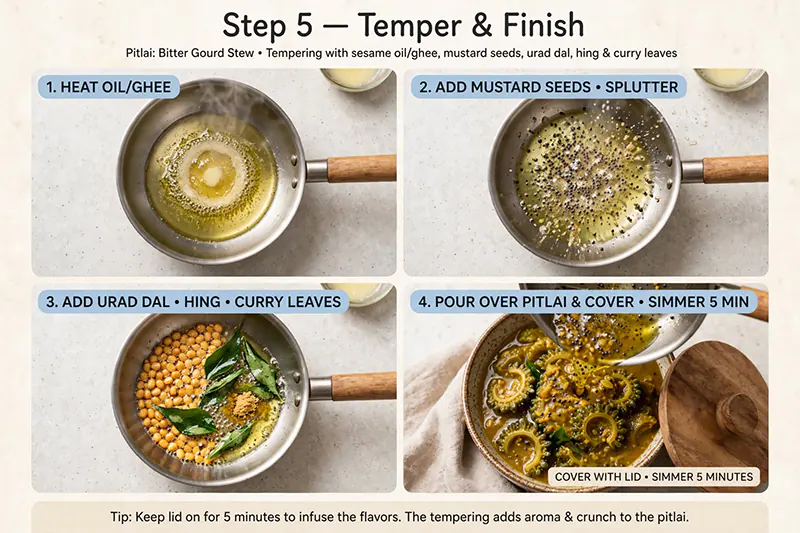
Step 5: Temper and Finish
- Heat 1 tbsp of sesame oil (or ghee) in a small tadka pan over medium heat.
- Add 1/2 tsp mustard seeds and let them splutter completely.
- Add 1/2 tsp urad dal and fry for 20 seconds until golden.
- Add 1/4 tsp asafoetida (hing) and a sprig of fresh curry leaves. Let the leaves crackle for 5 seconds.
- Immediately pour this aromatic tempering over the simmering pitlai. Cover the pot with a tight lid for 5 minutes to trap the aromas before serving.
Pro-Tips for Best Results
- Control the Coconut Roast: The distinct flavor of pitlai comes from toasting the coconut. Keep the heat strictly low; under-toasting leaves it tasting like everyday kootu, while scorching makes the stew bitter.
- Do Not Boil Dal in Tamarind Directly: Always cook toor dal separately. Lentils do not soften properly in acidic tamarind water.
- Resting Enhances Flavor: Like most tamarind-based South Indian gravies, pitlai tastes significantly better 1 to 2 hours after cooking, as the bitter gourd absorbs the sour, salty, and spicy elements of the sauce.
Troubleshooting Common Issues
- The gravy is unpleasantly bitter:
- Fix: Stir in an additional 1/2 teaspoon of powdered jaggery and a tablespoon of whisked mashed dal or warm water. Allow it to simmer for 2 minutes to restore balance.
- The pitlai turned out too thin and watery:
- Fix: Mix 1/2 teaspoon of rice flour with 2 tablespoons of water into a smooth slurry. Stir it into the simmering pitlai and cook for 2 minutes; it will gloss and thicken immediately.
- The gravy separated into clear water and grainy solids:
- Fix: This happens when the coconut paste is ground too coarsely or boiled too vigorously after adding the dal. Whisk a ladleful of the warm gravy in a cup until smooth, stir it back in, and keep the flame on low.
Variations You Can Try
- Konda Kadalai Pavakkai Pitlai (With Black Chickpeas): Soak 1/3 cup of dry black chickpeas overnight, pressure cook for 5–6 whistles until tender, and add them alongside the bitter gourd in Step 3. This is the most popular festival variant.
- No-Coconut Version: While traditional pitlai is defined by coconut, you can double the chana dal in the spice paste (to 2 tbsp) for a lighter everyday curry that still maintains thickness.
- Mixed Vegetable Pitlai: Replace half the bitter gourd with white pumpkin (ash gourd), yellow pumpkin, or drumstick to introduce natural sweetness against the bitter gourd.
How to Serve Bitter Gourd Pitlai
- The Classic Lunch Plate: Serve hot with steamed Sona Masoori or Ponni boiled rice, a teaspoon of melted ghee, and crunchy roasted papad (appalam).
- Balancing Side Dishes: Because pitlai has complex, bold flavors, balance it with mild sides like cabbage poriyal, carrot-beans thoran, or a cooling cucumber pachadi (raita).
- South Indian Dinner: It also pairs well with soft idlis, dosas, or warm rotis.
Storage & Reheating Instructions
- Refrigeration: Store cooled pitlai in an airtight glass or food-grade stainless steel container in the refrigerator for up to 3 days.
- Reheating: The lentils and chana dal cause the gravy to thicken considerably upon cooling. Reheat in a saucepan over medium-low flame, adding 2 to 3 tablespoons of warm water to loosen the consistency back to a pourable gravy.
- Freezing: Due to the fresh coconut content, freezing is not recommended, as thawed coconut tends to change texture and turn stale.
Frequently Asked Questions
Can I make this recipe using sambar powder instead of grinding fresh paste?
In an emergency, yes: simmer the bitter gourd in tamarind water with 1.5 tablespoons of sambar powder, then stir in 3 tablespoons of coconut ground with 1/2 teaspoon of roasted black pepper. However, grinding the fresh paste with whole chana dal, coriander, and toasted coconut gives pitlai its authentic flavor and texture.
Why is my bitter gourd still hard after cooking?
Bitter gourd must be cooked until completely tender in the tamarind liquid before the dal and coconut paste are added. If added too late, or cooked over rushed high heat, the vegetable remains chewy. Ensure it is fork-tender at Step 3.
Is pitlai gluten-free?
It is naturally gluten-free if you use pure, uncompounded asafoetida (hing). Most commercial powdered hing brands contain wheat starch; check the packaging or omit hing if catering to celiac needs.
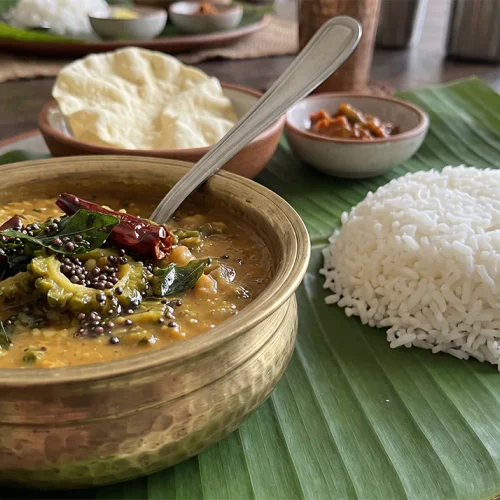
Traditional Bitter Gourd Pitlai (Pavakkai Pitlai)
Ingredients
- 2 medium bitter gourd approx. 200g, cut into 1/2-inch semi-circles
- 1/2 cup toor dal split pigeon peas
- 1 lemon-sized ball tamarind soaked in 1 cup warm water to extract juice
- 1/2 tsp turmeric powder divided
- 1 tsp jaggery powdered
- 1.25 tsp rock salt adjust to taste
- 1/3 cup boiled black chickpeas optional
- 2.5 cups water total for cooking
For Fresh Pitlai Paste:
- 1 tsp sesame oil
- 1 tbsp chana dal
- 1 tbsp coriander seeds
- 1/2 tsp whole black peppercorns
- 4 dried red chillies
- 1/3 cup fresh grated coconut
- 3 tbsp water for grinding
For Tempering:
- 1 tbsp sesame oil
- 1/2 tsp mustard seeds
- 1/2 tsp urad dal
- 1/4 tsp asafoetida hing
- 8 –10 fresh curry leaves
Instructions
Cook Dal: Pressure cook toor dal with 1.5 cups water, 1/4 tsp turmeric, and 2 drops oil for 4 whistles until soft. Mash smooth; set aside.
Roast Masala: Heat 1 tsp oil in a pan. Roast chana dal, coriander seeds, black peppercorns, and red chillies on medium-low until golden (2 mins). Add grated coconut; toast until light golden-brown (2 mins). Cool and grind with 3–4 tbsp water into a smooth paste.
Boil Karela: In a pot, combine sliced bitter gourd, tamarind juice, 1/2 cup water, 1/4 tsp turmeric, and salt. Boil over medium heat for 10–12 minutes until bitter gourd is fork-tender. Add boiled black chickpeas if using.
Combine & Simmer: Stir the ground coconut-spice paste and jaggery into the cooked gourd. Simmer for 3 minutes. Stir in the mashed toor dal plus 1/2 cup water. Simmer on low heat for 4–5 minutes until the gravy turns glossy and thick.
Temper: Heat 1 tbsp oil in a small pan. Splutter mustard seeds, then add urad dal, hing, and curry leaves. Pour over the hot pitlai. Cover for 5 minutes before serving.
Recipe Notes
Toast the coconut gently on low heat to develop a rich, nutty flavor without scorching.
If the final dish tastes too sharp or bitter, stir in an extra 1/2 teaspoon of jaggery and a splash of water, then simmer for 1 minute.
Use sesame oil (gingelly oil) for authentic South Indian flavor.