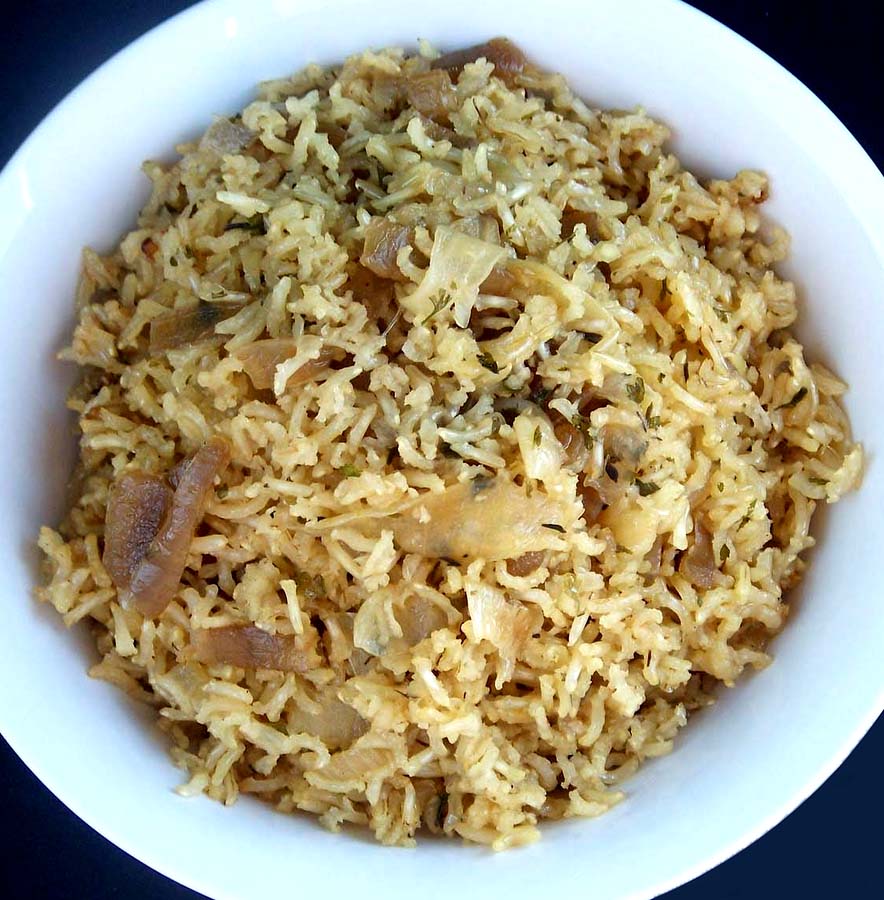
Dal Ka Seera (Traditional Moong Dal Halwa Recipe)
Dal Ka Seera is a classic North Indian and Rajasthani sweet made from soaked, coarsely ground yellow moong dal slow-roasted in pure desi ghee, then simmered with milk, sugar, saffron, and cardamom. It has a rich, grainy (danedar) texture, an amber-gold color, and an aroma of toasted lentils and warm spices.
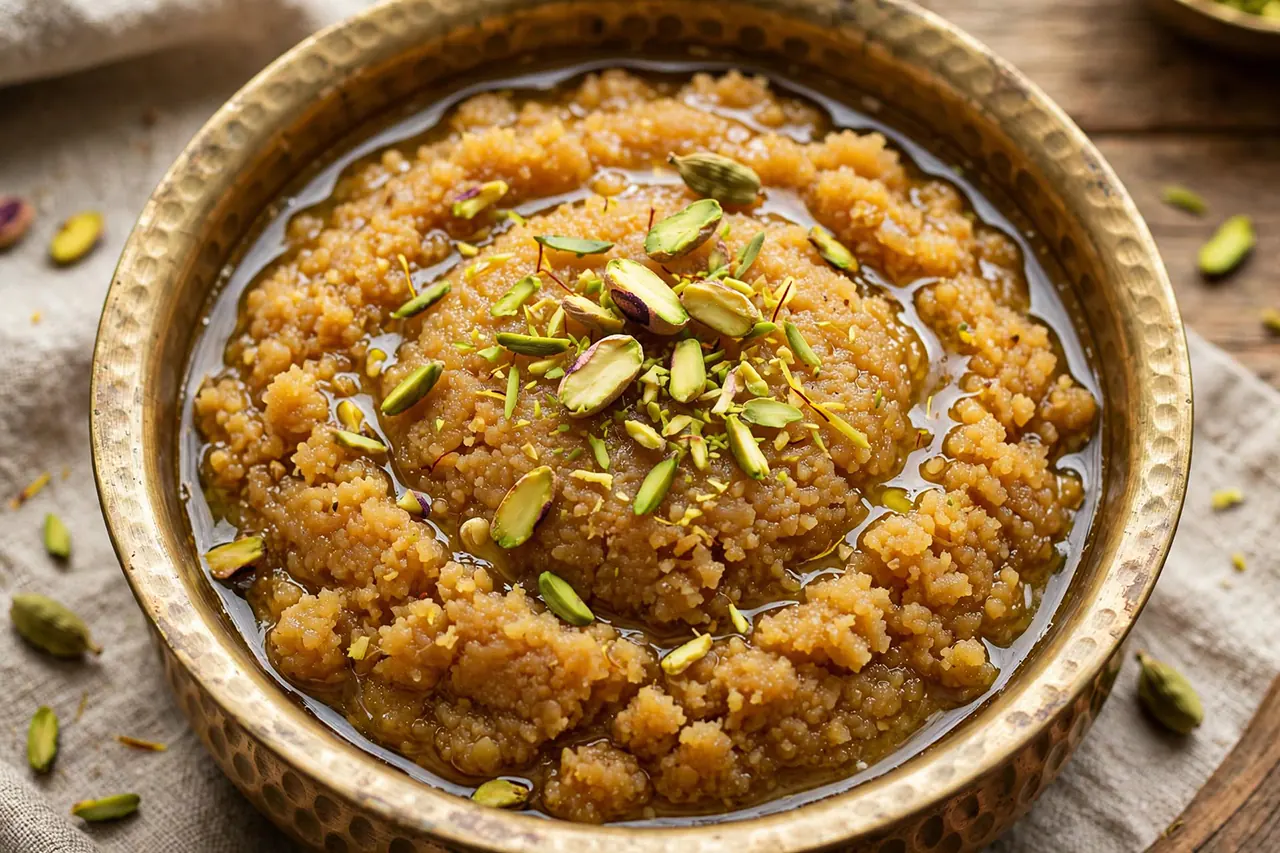
Making traditional dal ka seera at home requires patience rather than complex techniques. The secret to getting the authentic halwai-style result lies in two non-negotiable rules: slow-roasting the dal over a low flame until the raw lentil starch completely cooks out, and adding warm liquids before the sugar so the grains bloom into a tender, melt-in-the-mouth consistency.
The Classic 1:1:1:1 Halwai Ratio
Authentic Indian sweet makers (halwais) scale Dal Ka Seera using equal volume measurements of the four core components:
- 1 Part Moong Dal (Measured dry, before soaking)
- 1 Part Desi Ghee
- 1 Part Sugar
- 3 to 4 Parts Warm Liquid (A combination of full-fat milk and water)
Keeping this ratio intact ensures the sheera neither turns out chalky and dry nor leaves an unabsorbed pool of oil in the pan.
Ingredients
For the Dal Paste:
- Yellow Moong Dal (Split & skinned green gram): 1 cup (200 grams)
- Water: For soaking the lentils
For Roasting (Bhunai):
- Desi Ghee: 1 cup (200–220 grams), melted
- Sooji (Semolina / Fine Rava): 1 tablespoon (Optional culinary secret: prevents the moong dal paste from forming stubborn clumps when it first hits the hot ghee)
- Besan (Gram Flour): 1 tablespoon (Adds a deeper nutty aroma and golden hue)
For the Liquid Base:
- Full-Fat Whole Milk: 2 cups (500 ml), warm
- Water: 1.5 cups (375 ml), warm
- Saffron Strands (Kesar): 15–20 threads, soaked in 2 tablespoons of warm milk
For Sweetening & Flavoring:
- Granulated Sugar: 1 cup (200 grams)
- Green Cardamom Powder (Elaichi): 1/2 teaspoon, freshly ground
- Almonds & Cashews: 2 tablespoons each, sliced or chopped
- Pistachios: 1 tablespoon, finely slivered (for garnish)
Ingredient Notes & Practical Choices
- Yellow Moong Dal: Use unpolished split yellow lentils for the cleanest flavor and smooth texture. Ensure the lentils are thoroughly rinsed until the wash water runs clear to remove excess surface starches that cause scorching.
- Desi Ghee: Do not substitute with butter, vegetable oil, or margarine. Ghee has the high smoke point required for 25–30 minutes of uninterrupted roasting and provides the essential rich flavor profile of authentic seera.
- Milk vs. Water Balance: Cooking dal ka seera entirely in milk makes it heavy and prone to scorching. Using half milk and half water allows the dal grains to absorb moisture freely while still developing the creamy mouthfeel of reduced milk solids (mawa flavor) naturally.
How to Make Dal Ka Seera (Step-by-Step)
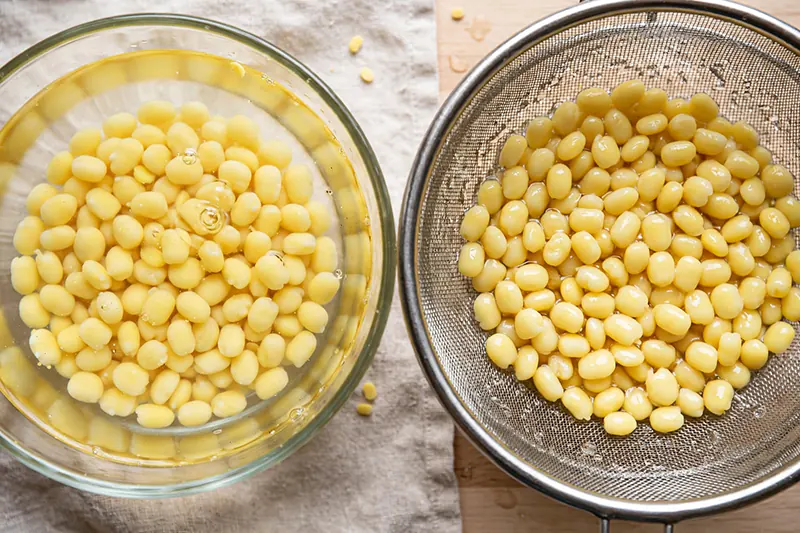
Step 1: Wash, Soak, and Drain the Dal
- Measure 1 cup of yellow moong dal into a bowl. Rinse it under cold running water 3 to 4 times, rubbing gently between your fingers, until the water is no longer cloudy.
- Cover with plenty of clean water (at least 3 inches above the dal level) and soak for 3 to 4 hours.
- Drain the dal thoroughly using a fine-mesh colander. Let it sit in the sieve for 10 minutes to eliminate excess moisture. Culinary check: If the soaked dal is dripping wet, it will splutter violently in the ghee and drastically prolong your roasting time.
Step 2: Grind to a Coarse (Darbara) Texture
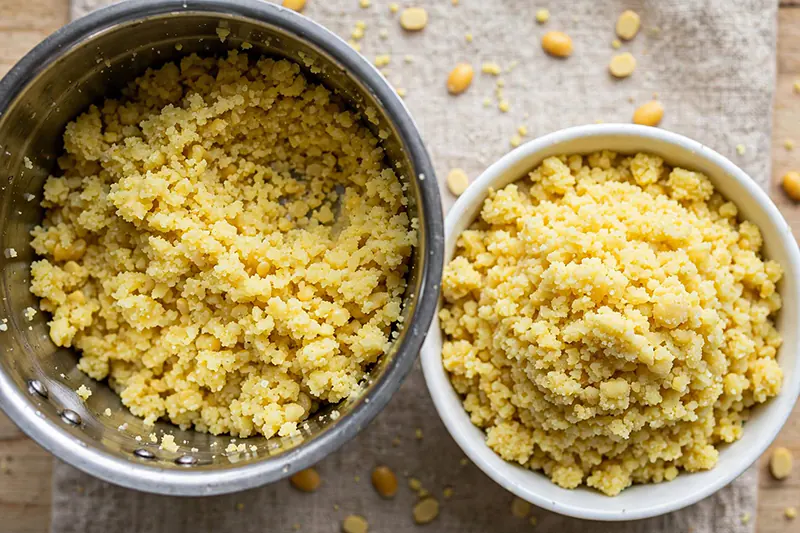
- Transfer the drained dal to a mixer-grinder or food processor jar.
- Pulse in short 3- to 5-second bursts without adding any water. If the blades spin freely without catching, add only 1 to 2 tablespoons of water maximum.
- Stop when the paste reaches a darbara (semi-coarse, fine semolina-like) consistency. It should feel gritty when rubbed between your index finger and thumb, not like a smooth, gluey batter.
Step 3: Heat the Liquid Base
- In a separate saucepan, combine 2 cups of full-fat milk, 1.5 cups of water, and the saffron threads.
- Place over low-medium heat and bring to a gentle simmer.
- Turn off the heat and keep this liquid mixture warm on an adjacent burner.
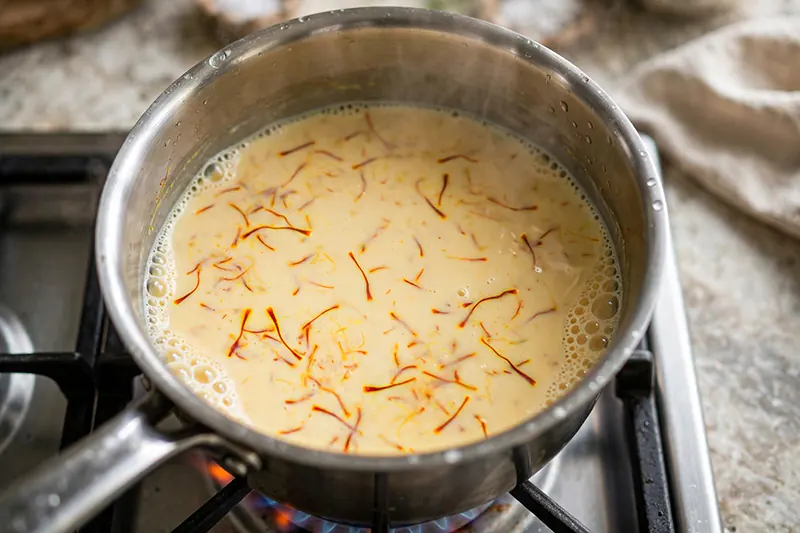
Step 4: The Initial Searing Stage (Heavy Paste)
- Place a heavy-bottomed kadai, brass pan, or cast-iron skillet over medium-low heat. Add 1 cup of desi ghee and let it melt.
- Add 1 tablespoon of sooji and 1 tablespoon of besan to the warm ghee. Stir for 30 to 45 seconds until tiny bubbles form around the edges.
- Lower the flame to absolute minimum. Add the ground moong dal paste into the ghee.
- Stir vigorously with a sturdy flat wooden spatula. During these first 5 to 7 minutes, the dal paste will absorb all the ghee like a sponge and form a heavy, dough-like ball that sticks to the bottom and sides of the pan. Do not add extra ghee. Keep scraping the bottom continuously.
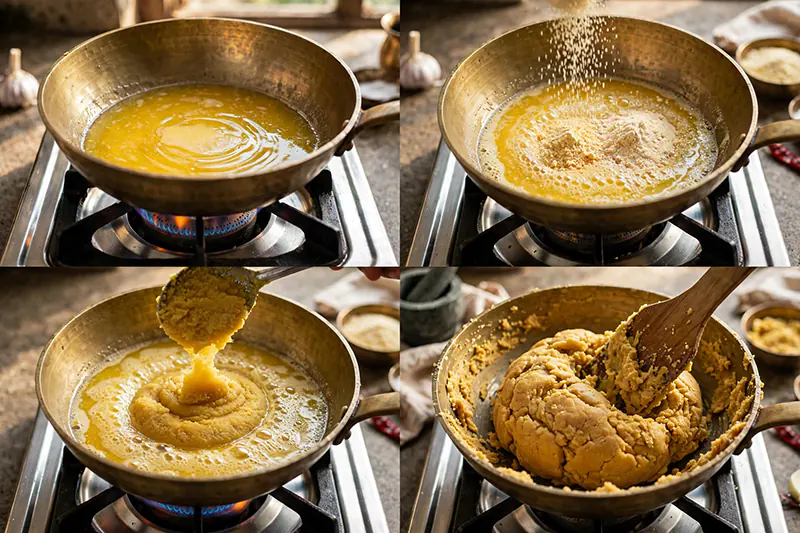
Step 5: The Crumbly Roasting Stage (Sandy Texture)
- Keep the flame on low to medium-low. Never rush this on high heat.
- Between 10 and 18 minutes, the dal will begin breaking apart from a sticky mass into separate, grainy crumbs resembling damp beach sand.
- Continue stirring and turning the mixture over every 20–30 seconds. The resistance against your spatula will decrease noticeably as the starches cook through.
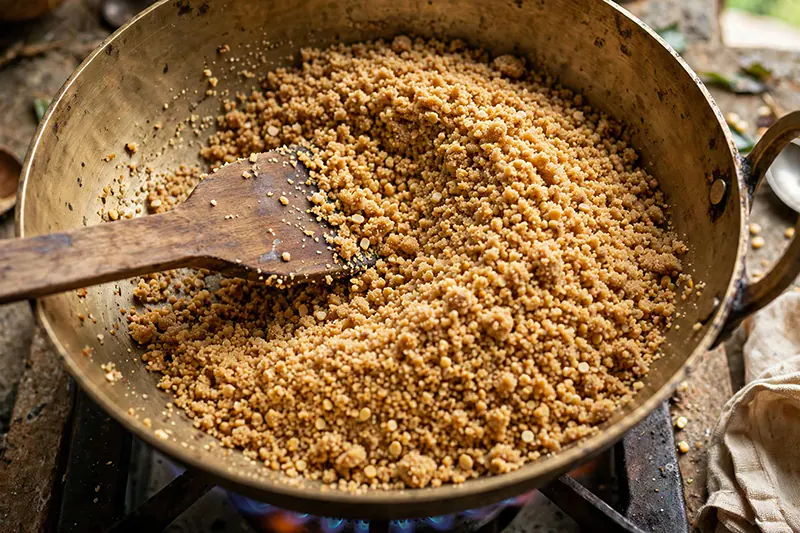
Step 6: The Golden Release Stage (Aromatics & Ghee Separation)
- Between 20 and 28 minutes, the grains will turn a rich, warm, pinkish-golden or light amber color.
- You will observe two clear doneness indicators:
- A distinct, sweet, nutty aroma of roasted lentils will fill the kitchen.
- Ghee will begin separating from the grains, making the mixture feel light, airy, and glossy in the pan.
- Add the chopped almonds and cashews directly into the hot dal mixture at this point. Roast them together for 1 to 2 minutes until the nuts turn light golden.
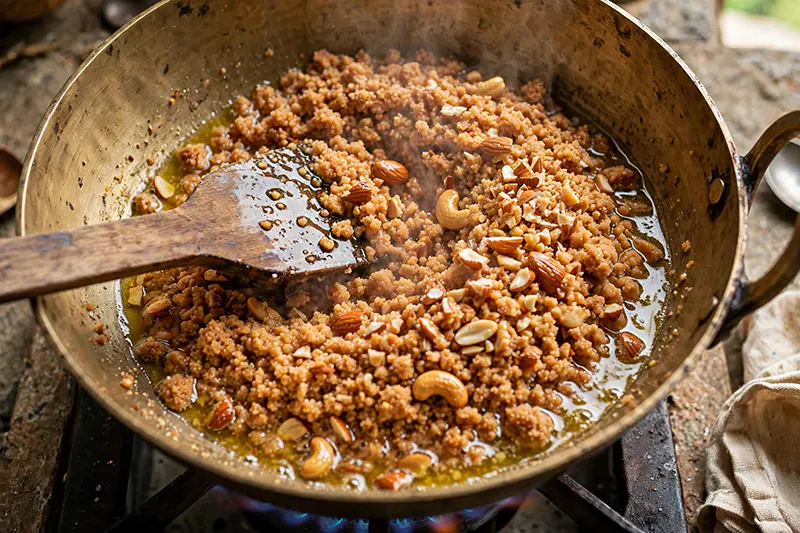
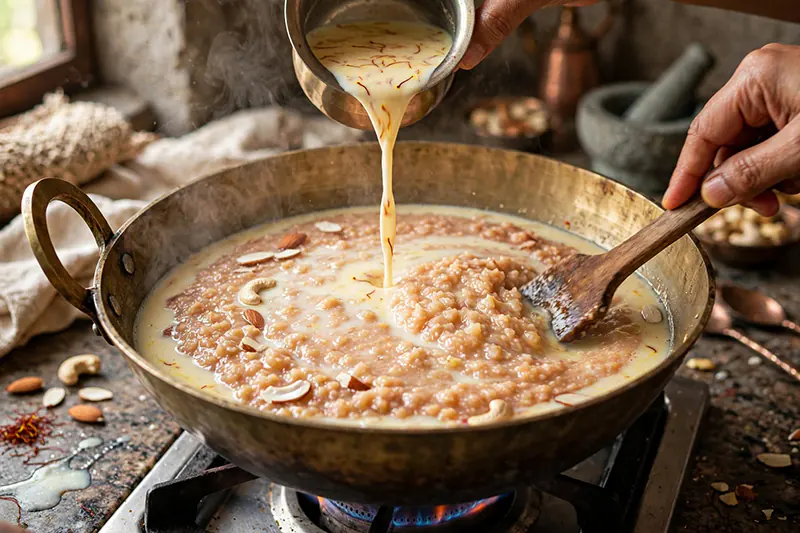
Step 7: Adding the Warm Liquid
- Keep the stove on the lowest setting.
- Pour in half of the warm milk-saffron-water mixture slowly with one hand while stirring continuously with the other. The mixture will bubble and release substantial steam.
- Pour in the remaining warm liquid. Whisk or stir firmly to ensure no dry pockets or lumps remain.
- Cook over medium-low heat for 4 to 6 minutes, stirring frequently, until the dal grains absorb the liquid, swell up, and form a thick, soft porridge-like texture.
Step 8: Adding Sugar and Final Dum Cooking
- Add 1 cup of granulated sugar and 1/2 teaspoon of freshly crushed green cardamom powder.
- Once the sugar melts, the halwa will loosen up and look temporarily thin and glossy.
- Continue cooking on low flame for another 5 to 7 minutes, stirring steadily.
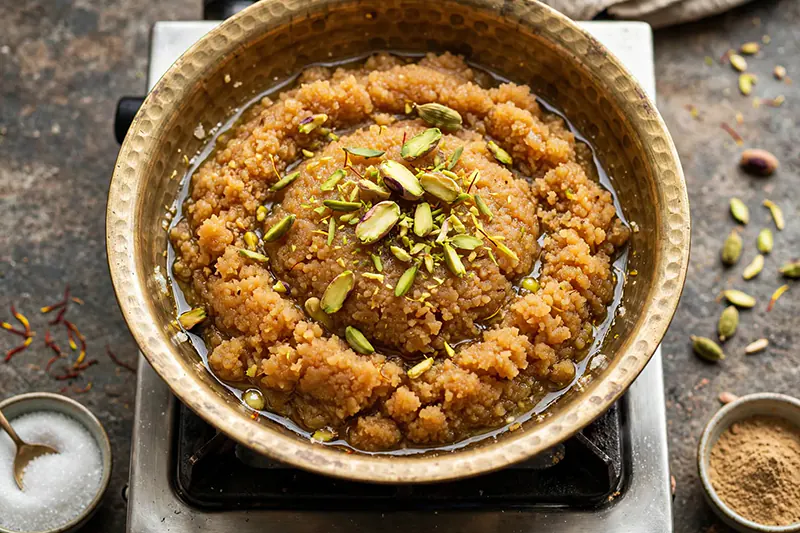
- The seera is completely done when it leaves the sides of the pan cleanly, rolls together as you stir, and droplets of ghee separate along the perimeter.
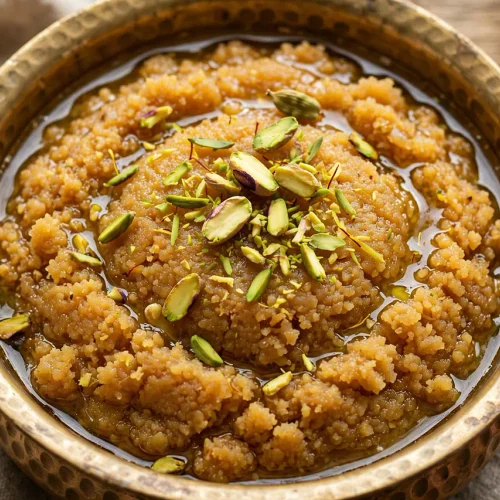
- Turn off the heat. Garnish with slivered pistachios and serve warm.
4 Rules for Perfect Dal Ka Seera
- Use a Heavy-Bottomed Pan: Moong dal has a high starch content and scorches rapidly on thin stainless-steel surfaces. An iron kadai, heavy anodized pan, or thick-bottomed brass vessel distributes the heat evenly across the 25-minute bhunai period.
- Never Add Cold Liquids: Introducing cold milk or water directly from the refrigerator into 160°C hot roasted dal causes thermal shock, uneven lump formation, and severe splattering of boiling ghee. Always keep the liquid warm.
- Respect the Sugar Sequence: Sugar is hygroscopic—it locks moisture in place. If you add sugar before the dal grains have expanded in the milk, the lentils will stay hard and develop a chalky, rubbery bite that cannot be fixed by further cooking.
- Patience on the Flame: Cooking moong dal paste over high heat darkens the exterior of the grains in 8 minutes while leaving the interior raw. Undercooked moong dal has a flat, beany flavor and feels sticky in the mouth.
Troubleshooting Common Issues
- Problem: The mixture is sticking aggressively to the pan during the first 5 minutes.Cause: This is normal behavior as uncooked lentil starch hydrates and gelatinizes.Fix: Lower the heat, switch to a flat-edged wooden turner or steel spatula, and scrape the bottom cleanly. As the dal roasts and sheds internal water, it will naturally release from the metal.
- Problem: Dal grains feel hard, dry, or gritty after adding sugar.Cause: The dal was undercooked before liquid was added, or sugar was introduced before the grains fully absorbed the moisture.Fix: Sprinkle 1/4 cup of boiling hot water over the surface, cover the kadai with a tight-fitting lid, and let it steam (dum) over the lowest possible flame for 4 to 5 minutes.
- Problem: The halwa looks dull and dry rather than glossy.Cause: Ghee measurement was reduced, or liquid evaporated too quickly over high heat.Fix: Warm 1 to 2 tablespoons of desi ghee in a small ladle and fold it gently into the hot sheera just before serving.
Recipe Variations
- Khoya / Mawa Dal Ka Seera: For special occasions or weddings, add 50 grams of crumbled unsweetened khoya (mawa) to the pan right after the dal paste finishes roasting, cooking it for 2 minutes before pouring in the warm liquid.
- Jaggery (Gud) Version: Replace the 1 cup of refined white sugar with 1 cup of grated dark organic jaggery. Dissolve the jaggery in the warm water portion, strain out impurities, and fold it in at Step 8. This produces a rustic, deep caramel flavor profile.
Serving Suggestions
Serve Dal Ka Seera hot or warm in small bowls, garnished with additional slivered pistachios and a few strands of saffron.
In traditional Rajasthani and Marwari celebratory meals, Dal Ka Seera is served alongside savory, spicy dishes such as Dal Baati Churma, Mirchi Vada, or Khasta Kachori, creating a classic sweet-and-savory festival spread.
Storage & Reheating Instructions
- Refrigeration: Store cooled Dal Ka Seera in an airtight glass or stainless-steel container in the refrigerator for up to 7 days. The desi ghee will solidify, turning the halwa firm and dense.
- Freezer Storage: You can freeze dal ka seera for up to 1 month. Thaw overnight in the refrigerator before reheating.
- How to Reheat Properly:
- Stovetop Method (Best Texture): Place the cold sheera in a small pan, sprinkle 1 to 2 tablespoons of warm milk or water over the top, cover with a lid, and warm over low heat for 3 to 4 minutes. Stir gently; the ghee will melt back into the grains, restoring its original soft, glossy texture.
- Microwave Method: Heat in a microwave-safe bowl in 30-second bursts, stirring between each burst, until heated through (approx. 60–90 seconds total).
Frequently Asked Questions
Why must moong dal be ground coarsely instead of smooth?
Grinding moong dal into a completely smooth purée breaks the starch granules excessively, resulting in a pasty, gluey halwa that sticks to your palate. A coarse, rava-like grind (darbara) allows the individual grains to separate during slow-roasting, producing the signature grainy (danedar) texture.
Can I reduce the amount of ghee in Dal Ka Seera?
You can reduce the ghee to 3/4 cup without ruining the recipe, but reducing it further is not recommended. Ghee serves as the primary heat-transfer medium during the 25 minutes of continuous roasting; without adequate fat, the dense lentil paste will scorch and stick instead of roasting evenly.
How long does it take to roast moong dal paste completely?
On a domestic stove over medium-low to low heat, roasting 1 cup of soaked dal paste typically takes 22 to 28 minutes. Never rely on the clock alone; verify that the mixture turns a light pinkish-amber color, smells intensely nutty, and clearly releases ghee around the edges.
Can I make this with moong dal flour instead of soaked dal?
Yes, this alternative is known as the “instant” method. However, the soaked-and-ground technique produces a significantly lighter, more porous crumb that absorbs the saffron-infused milk more effectively than commercial dry flour.
Dal Ka Seera (Traditional Moong Dal Halwa)
Authentic Indian sweet recipe of soaked yellow moong dal slow-roasted in desi ghee with milk, saffron, and sugar.
Ingredients
- – 1 cup 200 g yellow moong dal (split, skinned green gram)
- – 1 cup 210 g desi ghee (clarified butter)
- – 1 tbsp fine sooji semolina
- – 1 tbsp besan gram flour
- – 2 cups 500 ml full-fat milk, warm
- – 1.5 cups 375 ml water, warm
- – 15-20 strands saffron kesar
- – 1 cup 200 g granulated sugar
- – 1/2 tsp green cardamom powder freshly crushed
- – 2 tbsp sliced almonds
- – 2 tbsp chopped cashews
- – 1 tbsp slivered pistachios for garnish
Instructions
- Wash the moong dal thoroughly and soak in clean water for 3 to 4 hours. Drain completely.
- Pulse the dal in a mixer grinder without water (or with 1 tbsp max) to a semi-coarse (darbara) paste.
- In a saucepan, warm the milk, water, and saffron together; keep warm over low heat.
- In a heavy-bottomed kadai, melt the ghee over low flame. Add sooji and besan; sauté for 30 seconds.
- Add the ground dal paste. Stir constantly over low-medium heat. The paste will absorb ghee and turn into a sticky ball for the first 8-10 minutes.
- Continue slow-roasting for 20-25 minutes until the dal turns sandy, reaches an amber-gold color, smells nutty, and releases ghee freely.
- Add almonds and cashews; roast for 1 minute in the hot dal mixture.
- Reduce heat to low. Carefully pour in the warm milk-saffron liquid in a steady stream while stirring continuously to eliminate lumps.
- Simmer for 4-5 minutes until the dal absorbs the liquid and fluffs up into a thick mixture.
- Add sugar and cardamom powder. Stir well as the mixture loosens, cooking for another 5-7 minutes until the seera leaves the sides of the pan and ghee separates at the edges.
- Turn off heat, garnish with pistachios, and serve warm.
Recipe Notes
- Always warm the milk and water before adding them to the hot roasted dal to prevent steam splatter and lumps.
- Never add sugar until the dal has fully absorbed the milk liquid.
Storage:
- Refrigerate in an airtight container for up to 7 days. Reheat on the stove with 1-2 tbsp warm milk.